


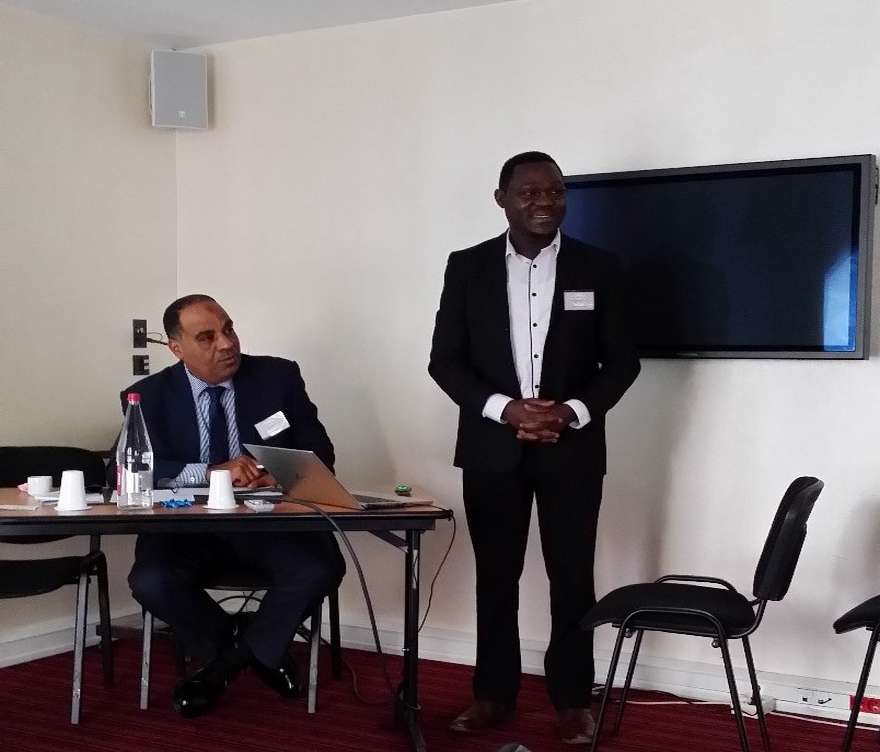


ICFR 2015
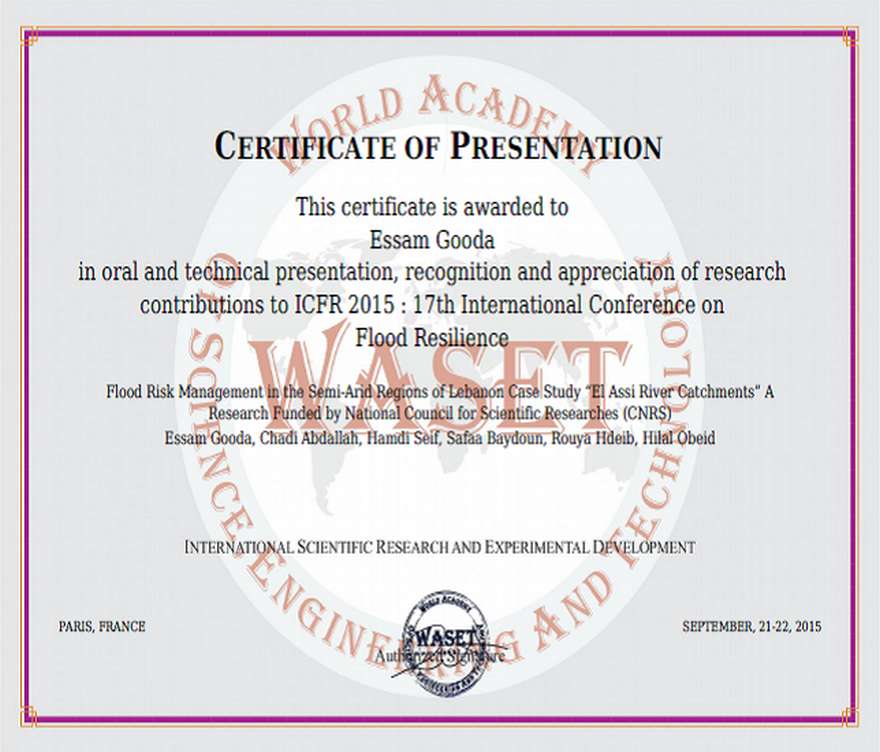
21 September 2015Flood Risk Management in the Semi-Arid Regions of Lebanon
Case Study “El Assi River Catchments”
A research Funded by National Council for Scientific Researches (CNRS)
Essam Gooda, Prof. of Water Resources Engineering- B.A.U
Dr. Chadi Abdallah, CNRS – Remote Sensing Center
Hamdi Seif, Prof. of Environmental Engineering-B.A.U
Dr. Safaa Baydoun, Research Center for Environment & Development-B.A.U
Eng. Rouya Hdeib, CNRS-Remote Sensing Center
Hilal Obeid, M.S Civil & Environmental Engineering-B.A.U
Abstract
This paper discusses different levels of integration approaches between GIS and hydrological models (HEC-HMS & HEC-RAS) and presents a case study, in which all the tasks of creating model input, editing data, running the model, and displaying output results. The study area corresponds to the East Basin of Orontes River (Ras Baalbeck & Fakeha), comprising nearly 350 km2 and situated in the Bekaa Valley of Lebanon. The case study presented in this paper has a database which is derived from Lebanese Army topographic maps for this region. ArcMap was used to digitizing the contour lines, streams & other features from the topographic maps. The digital elevation model grid (DEM) was derived for the study area. The next steps in this research were to incorporate rainfall time series data from Arseal, Fekha and Deir El Ahmar stations to build a hydrologic data model within a GIS environment and to combine ArcGIS/ArcMap, HEC-HMS & HEC-RAS models, in order to produce a spatial-temporal model for floodplain analysis at a regional scale.
In this study, HEC-HMS and SCS method were chosen to build the hydrologic model of the watershed. The model then calibrated using flood event that occurred between 7th & 9th of May 2014 which considered exceptionally extreme because of the length of time the flows lasted (15 hours) and the fact that it covered both the watershed of Aarsal and Ras Baalbeck. The strongest reported flood in recent times lasted for only 10 hours covering only one watershed.
The calibrated model was then used to build the hydraulic model & assess flood hazard maps for the region. Field trips were done for the catchments in order to calibrate both hydrologic and hydraulic models.
Introduction
Floods are common natural disaster occurring in semi-arid regions in Lebanon. This results in damage to human life and deterioration of environment. Despite their destructive nature and their immense impact on the socio-economy of the region, flash floods have not received adequate attention from policy and decision makers. This is mainly because of poor understanding of the processes involved and measures needed to manage the problem. The current understanding of flash floods remains at the level of general concepts; most policy makers have yet to recognize that flash floods are distinctly different from normal riverine floods in term of causes, propagation, intensity, impacts, predictability, and management. Flash floods are generally not investigated as a separate class of event but are rather reported as part of the overall seasonal flood situation. As a result, Lebanon generally lacks policies, strategies, and plans relating specifically to flash floods.
Main objective of this research is to improve flash flood prediction by using powerful models to help understanding the hydrological processes governing flash floods in the East Catchments of Orontes River. This includes developing rainstorm time distribution curves that are unique for this type of study region; analyzing, investigating, and developing a relationship between arid watershed characteristics (including urbanization) and nearby villages flow flood frequency in RasBaalbeck and Fekha.
The presented models (GIS, Hec-HMS & Hec-RAS) are a kind of flexible procedures for an ungaged watershed. For some storm events it delivers good results, while for others, more data should be collected through field visits. In order to have a general methodology based on these ideas; further calibration and compromising of results on the dependence of many flood events parameters and catchment properties are required.