




Contemporary Developments in the Contract Law A seminar at BAU
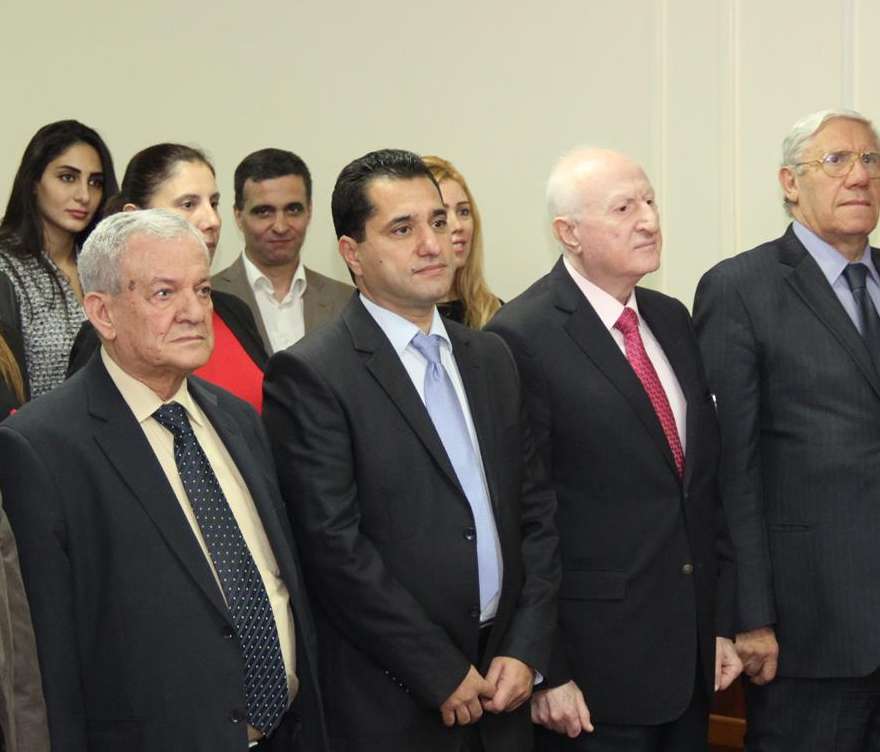
09 November 2015The Faculty of Law and Political Science at Beirut Arab University organized a seminar entitled “Contemporary Developments in the Contract Law”. The event that was held on the 9th of November 2015 was attended by Prof. Amr Galal El Adawi, President of BAU; Prof. Ali Ibrahim, Fiscal Prosecutor in Lebanon; Prof. Ramez Ammar, Dean of Political, Administrative and Diplomatic Sciences at the Islamic University in Lebanon; Mr. Omar Zein, Secretary General of the Arab Lawyers’ Federation and the Beirut Bar Association; Mr. Ahmed Safsouf, ex-Secretary General of the Beirut Bar Association; Prof. Mayssah El Nayal, Dean of the Faculty of Arts; as well as the staff-members at the Faculty and a crowd of students.
Prof. Mohamed Kassem, Dean of the Faculty, opened the event with a discussion of “The Penalty for Breaching a Contract: A Contract as a Binding Force and its Economic Role”. In his discussion, the Dean pointed out that a contract is not an end in itself, but rather a means towards an economic goal that the parties to the contract aim at achieving. He further established that the development that contracts have seen in these terms relate to whether a contract is of binding force, i.e. it may not be repealed, amended or terminated, except upon the full agreement of all parties concerned. This development has two basic aspects: first, a contract may be repealed by the individual will of one of the contractors, without need to resort to litigation, which may take much time and may bring harm to the creditor who has fulfilled their obligations. The second concerns the absence of proactive implementation, which grants either party to the contract to refrain from the implementation of their obligation when they expect that the debtor will not fulfill their obligation when due.
Prof. Sami Mansour, Honorary Presiding Judge of the Court of Cassation, on the other hand, tackled the issue under the title “The Development of the Notion of Contracts in Terms of the Relativity of Contracts in the Lebanese Judiciary”. In his speech he pointed out that the principle of relativity in contracts has undergone great developments, for contracts no longer have a relative impact, but are rather effective vis-à-vis other parties that abide by the contract without being party to it. Such other parties may also abide by what is stipulated in the contract, in the case of the economic unity of contracts or related contracts. Such contracts are thus effective and extend in their impact to other than its parties. If such contracts include an article or an arbitration contract, they apply to those who are not a party to the contract.
Prof. Abdou Ghassoub, Appeal Lawyer, discussed “The Legislative Constancy in International Contracts which the State is Party to”, clarifying that the parties often resort to the temporal freezing of a contract by force of an explicit stipulation that states that the law of will does not apply to the concluded contract, except in the very form it was concluded in, excluding all amendments that may subsequently be made to it.
Prof. Ghassoub also pointed out that this protects the foreign party entering a contract with the state from any subsequent amendments made to the Contract Law, which may not be compatible with their commercial interests, or at least may collide with their expectations. He also maintained that the legislative constancy has become a familiar issue in state contracts, where the state is bound by such article not to issue any new legislations applicable to the concluded contract, in such a way as to lead to an economic imbalance of the contract and causing damage to the foreign contracting party.